

Australia > Accommodation

Australian Travel Accommodation
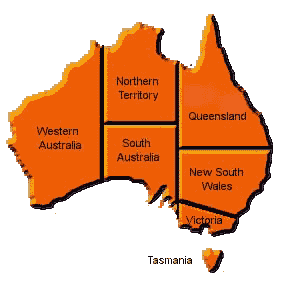
including Sydney, Byron Bay
including darwin
including brisbane, gold coast, cairns
including Adelaide
including Hobart
including Perth
including Melbourne
Australia
Australia is the Worlds largest island being 7,682,300 km square with a coastline of 36,735km. It is the size of the 48 mainland states of America with a population of only 21 million people.
Climate
Australia is located in the Southern Hemisphere. Summer extends from December to February, Autumn from March to May, Winter from June to August and Spring from September to November.
The tropics experience wet and dry seasons, summer being wet and hot and winter being dry. Over winter it is possible to Ski in Victoria and New South Wales Ski fields.
Money
Australia has its own unique currency. Coin 5, 10, 20, 50, $1, $2 Notes $5, $10, $20, $50, $100 One and two cent coins are no longer in circulation however prices of items still use these denomination's. Upon payment the total is rounded to the nearest increment.
Things to See
Australia is renowned for its endless vistas, flora and Fauna. Some of the most noticeable natural features include The Great Barrier, Ayres Rock, Kakadu National Park, Nullarbor Plain and Simpson Desert. Also not forgeting the Koala and Kangaroo.
Road Rules
Some basic road rules when travelling in Australia:
- Drivers must always keep to the left hand side of the road.
- Pedestrians should always look right first before crossing a road.
- Seat belts and child restraints must be worn by all vehicle occupants.
- Always carry a copy of your driver’s license in English.
- Drive no faster than the speed limit signs allow; and slower in rain or fog.
- Alcohol and driving don’t mix. For experienced drivers the blood alcohol level is 0.05. Provisional drivers and young drivers may not have any alcohol before driving.
- Fatigue causes many crashes in Australia. When driving long distances, stop and rest every 2 hours.
- All traffic must proceed in a clockwise direction in a roundabout. A vehicle already on a roundabout has right of way over any vehicles entering.
- Always overtake to the right. Be sure you can see enough of the road to complete overtaking and move back to your side of the road. Never overtake on corners, blind rises or on double white lines. When overtaking heavy vehicles in wet weather, beware of wind turbulence and wheel spray causing a reduction in visibility. Allow plenty of space behind you when pulling back in after passing a truck. Trucks can’t stop as quickly as cars, especially when carrying heavy loads.
Safe Driving
- Australia is an enormous country with driving conditions that can differ greatly from other countries. When calculating travelling time it is important to take into consideration the need to reduce speed through the many towns and cities. You will also need to consider adverse road and weather conditions.
- Australia is lucky to have many native animals living in their natural habitats. Enjoy them, but remember they can be a hazard on country roads. Although it is a natural instinct to swerve to avoid an animal, keep your vehicle on the same line, slow down, and stop if possible. Remember there may be an oncoming vehicle. It is preferable to cause minor damage to your car by colliding with an animal, rather than with another vehicle or immovable object.
- Remember that campervans are double the height and length of sedan vehicles. Keep an eye out for height indicator signs, cantilever awnings, overhanging tree branches and be careful when reversing near fixed objects (walls etc.).
- Remember the four basic survival rules if you are in an accident in a remote area:
- Do not leave your vehicle.
- Stay in the shade.
- Conserve water.
- Prepare effective signals.
Embassies
National Parks
Australia has an abundance of National Parks. There are over 500 throughout Australia with 13 being World Heritage listed. They include, The Great Barrier Reef, Kakadu and Ayres Rock (Uluru). You are likely to see some of Australias indigenous animals such as kangaroos and koalas in these preserved areas. For more information on National Parks use the links below for the State or Territory.

Transport
Air

Bus

Railway

Vehicle
Language
English is the official language of Australia, however interpreting services via telephone are readily available.
As Australia is a multi cultural country many other languages are spoken including Italian, Greek, Dutch, German, as well as a variety of Asian languages including Chinese and Japanese.
Entry into Australia
You will need a valid passport for entry into Australia. Most visitors also require a visa. Contact your nearest Australian Consulate Government representative to ascertain your particular requirements and procedures.
Telephone
Each State or Territory has their own state area code. When calling a number from within Australia to another State or Territory the states prefix must be at the start of the number. If you are calling STD or long distance within a state you should also use the states prefix at the start of the number. All states prefix's start with '0'.
- Queensland 07
- New South Wales 02 (also 03, 07, and 08)
- Victoria 03
- Tasmania 03
- South Australia 08
- Northern Territory 08
- Western Australia 08
- Australian Capital Territory 02
If you are calling Australia from overseas you must use the Australian prefix of '61' and delete to '0'.
For example calling a hostel in Melbourne from within Australia it would be 03 9123456. From outside Australia to call the same place the number would be 61 3 9123456.
mail@you.com.au
Copyright © 1998-2014 you.com.au